Shree Sai Baba and Sansthan Trust
On the South bank of the Godavari river, the holy land known as the Tapobhumi of Daityagu- ru (Guru of demons) Shukracharya, at about one hundred sixty seven years ago, Shree Sai Baba, who taught the world Shraddha (faith), Saburi (patience), peace, inter-religious harmony, equality and Sabka Malik Ek, arrived and the Daityabhoomi (land of demons) became Devbhoomi (land of Gods). Every bit of the land became pure with the presence and touch of Shree Sai Baba's feet. After living for nearly sixty years, the last breath Baba took at the Dwarkamai temple merged into the atmosphere here. His holy body is resting in the plinth of Samadhi in Buttiwada. Shree Sai Baba, who prompt to the call of devotees, is still testifying to millions of devotees around the world that whoever steps in Shirdi will be blessed with happiness and prosperity.
During Shree Sai Baba's life-time, despite the meagre means of dissemination, people from all over the world come to Shirdi and stay for many days. Baba's words, “No matter where my devotees in the world, I will bring them here. There will be crowd like ants in Shirdi,” which seems to be today's truth. Revealed for the welfare of mankind by overcoming the differences of caste, religion, creed and country, the faith of millions of dignitaries including the nation's Presidents, Prime Ministers, politicians, scientists, industrialists, high profiles, judiciary and administration, cinema artists and sociological dignitaries have been established.
Shree Sai Baba arrived in Shirdi around the year 1858. Baba's religion, caste, creed, origin, name are still a mystery. There is no convincing information about that. The name ‘Sai was given only when Baba came to Shirdi. Shree Sai Baba kindled the love of humanity among the devotees. Shree Sai Baba loved the poor, the weak and the animals. Baba used to help them in their difficulties and crises. During His long stay in Shirdi, Baba Himself cured the ailments of many devotees. Shree Sai Baba gave the teaching of Shraddha (faith) and Saburi (patience) is a great solution to the problems facing the worldly and transcendental people in the world. Devotees believe that the incurable diseases of many devotees are cured with the help of Udi in Dhuni which Baba has ignited Himself and the flame continues till today. The fame of such a great incarnate man spread everywhere and devotees of all religions began to be attracted towards Shree Sai Baba. Devotees used to come for the blessings at Shree Sai Baba's feet and offer dakshina in kind or money. Even today, people of all faiths and religions from all over the world come to visit Shri Sai Baba Samadhi, hence this Shree Sai Baba's Samadhi Mandir, the place of reverence, has taken the form of an integrated and universal temple.
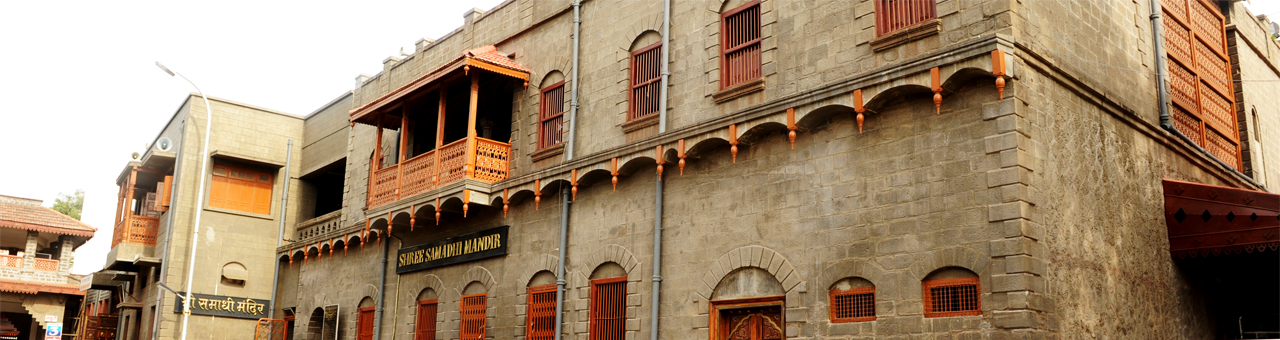
As per the wish of Shree Sai Baba, Gopalrao alias Bapusaheb Butti of Nagpur started the construction of Buttiwada in 1914. He wanted to place a statue of Muralidhar in the basement of the mansion. Baba's last words, “Please take me to the wada” ultimately became everybody's decision. Baba Himself became Muralidhar. (Chapter 44, Verse 36, Shree Sai Satcharita) Shree Sai Baba became one with the five divine principles on BharatTya śuddha saura 7 śake 1840, aśvina śudhda daśamT, Tuesday, 15th October, 1918 at noon. Following Shri Sai Baba's last command, “Take me to the wada,” all the devotees, including Butti, decided to build a samadhi in the place of the plinth, which was made for Muralidhar. After Shree Sai Baba left His physical presence, His holy body was kept in the magnificent wada built by the late Gopalrao Mukund Butti, the millionaire of Nagpur, as per Baba's wish. And, the same place is now known as the Samadhi Mandir. According to the wishes of some devotees, an organizing committee of the main devotees was formed and as such, the committee started worshipping Him as sadhu from that time onwards. And, from the day of Bhandara i.e. a religious feast, from 27th October 1918, a fund called Sai Samarth Sainath Kothi was started to continue-
worshipping in the temple and other places as before. Articles used by Shree Sai Baba were also kept in the temple. Arrangements were made for cleaning and maintaining the places where Shree Sai Baba used to seat, meet and interact with the devotees and the other places. The Organizing Committee filed a civil application of 1921 in the District Court of Ahmednagar (now known as Ahilyanagar) for reasonable assistance. Accordingly, on 13th February, 1922, the District Court approved a plan to manage the affairs of Shree Sai Baba Sansthan Trust properly and for the maintenance of the assets and property owned by the Sansthan Trust. After that, the Court representatives came to Shirdi and handed over the real estate (property) to Mr. Moreshwar Pradhan and four other trustees. Then,
the first committee was established under the chairmanship of late Dasganu Maharaj. The first meeting was conducted on 6th April, 1922 on the occasion of Shree Ram Navami. It had 15 members including five life members.
The powers vested in the committee were amended from time to time by amending the existing laws. These amended laws were enforced on October 1, 1941. Subsequently, the District Court made some changes in the plan in response to Miscellaneous Application No. 17 of 1951 and almost approved the original plan of 1922 at that time. It was decided that the administration of the Sansthan Trust should be run in a transparent and democratic manner. As the new scheme of 1951 was self-contained, it almost cancelled the clauses in the old scheme of 1922. In 1951, the District Court empowered the Managing Committee to make rules and regulations. Accordingly, on 13th September, 1954, the sub-committee selected by the Bhaktmandal drafted the necessary laws and regulations and included in them all the detailed rules and regulations relating to all the schemes and arrangements. It was accepted at the Special General Meetings of the devotees held on Sth october 1955, 20th November 1955 and 18th December 1955. The necessary approval of the District Court in this regard was also received on 11th May, 1956 under Miscellaneous Application No. 20/56. These rules and regulations came into force on May 11, 1956. Accordingly, from 1956 to 1962, this committee was in charge of the Sansthan. Thereafter, from 1962 to 1984, the work of the Sansthan Trust was supervised by the Hon'ble Court Receiver under the control of Hon'ble Civil Court, Mumbai.
It was decided to make the funds collected through the Sansthan Trust considering the significant growth in the donations as well as the growing number of devotees and the facilities provided to them and the significant nature of the country, the concept of religious and charitable trusts of the society, for the welfare of the very poor, destitute and needy people. Similarly, a plan was prepared for better administration and control as per the order of the Hon'ble Civil Court, Mumbai, dated 18th October 1982 (Claim No. 3457/60). According to the plan, prepared by the Civil Court, Mumbai, the Management of the Sansthan Trust was under the control of the Charity Commissioner, State of Maharashtra, Mumbai, and through the Board of Trustees appointed by them from 1984 to the end of August, 2004.
Subsequently, the Government of Maharashtra in order to reorganise the public trust of the then registered public trust, Shirdi Sansthan of Shree Sai Baba, the statute of Shree Sai Baba Sansthan Trust, Shirdi Act, 2004 was passed. The purpose of the act was better management, administration and control of the trust, the trust can undertake a more comprehensive welfare scheme for the people. It has been enforced from 23/8/2004. In the year 2011, 2013 and 2017', some amendments were made in the above-mentioned act and the act was updated accordingly. The work of the Sans- than Trust is still going on today as per the said act.
Since Sai Baba's original name, caste and religion are unknown, devotees feel Shree Sai Baba as their closest one. Shree Sai Baba is considered as a symbol of eternal harmony among all religions all over the world. Shree Sai Baba's Samadhi centenary year was celebrat- ed from 1st October 2017 to 18th October 2018. Although we were not born during Shree Sai Baba's life-time, we all had the good fortune to witness Shree Sai Baba's centenary year.
Visiting Shree Sai Baba's Samadhi in this century has become an incredible and invaluable treasure and a golden moment in the life of devotees. Shree Saibaba Sansthan Trust, Shirdi, Shirdi Nagar Panchayat and villagers had organized various social and religious programmes to commemorate the historic period of Samadhi Shatabdi. Baba's Paduka (footwear) proces- sion tours were also organized in various cities of the country on this occasion. The manage- ments of Shree Sai Baba temples at various places also happily participated in it.